
Why Tennis Players Choke (and How the Best Recover)
From Novotna's double fault to Sinner's three lost match points, choking in tennis has a known cause and a trainable fix. Here is what the best do.
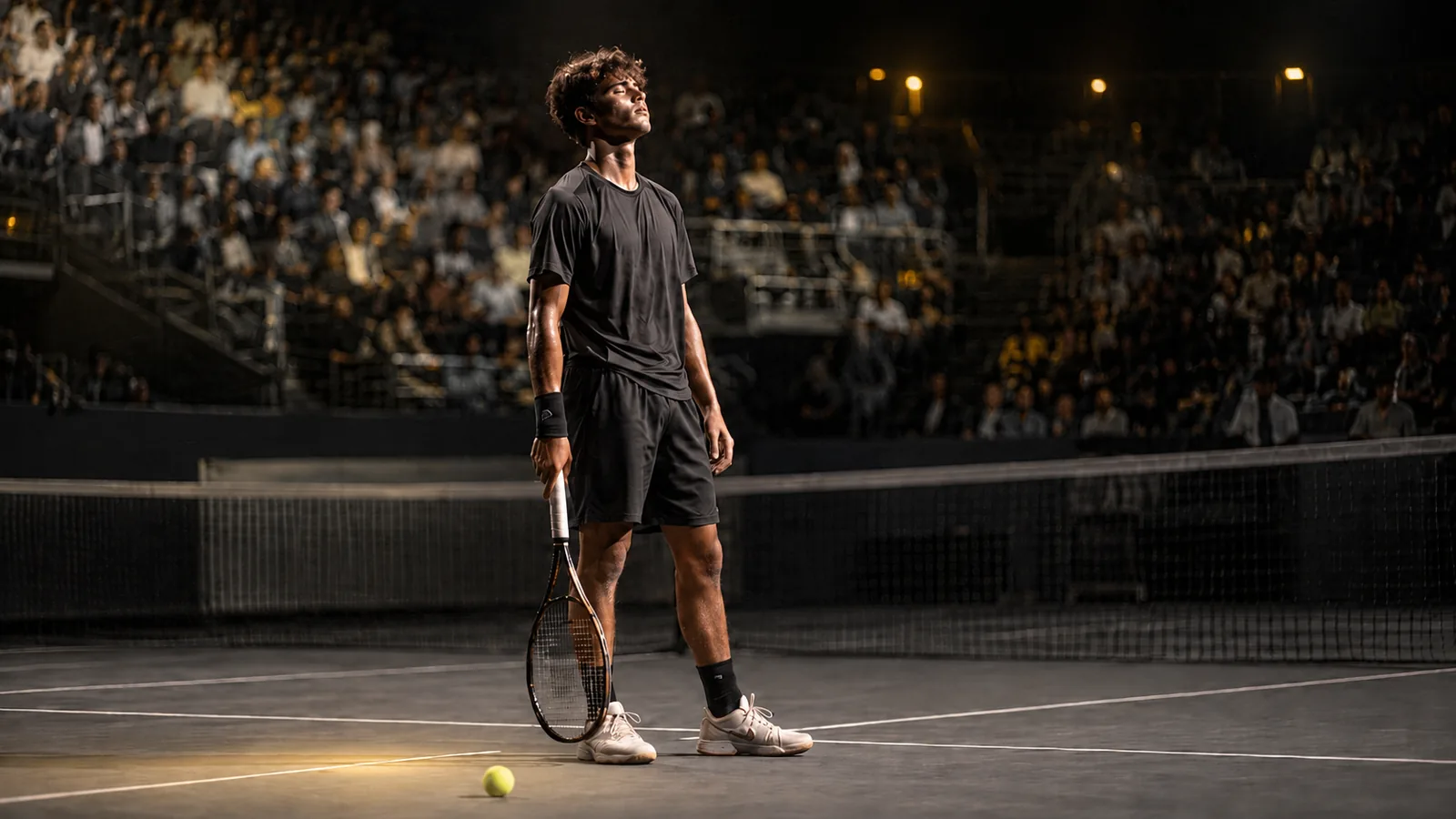
Choking is not weakness and it is not nerves. It is a wiring issue: under pressure, your brain grabs manual control of a skill you built to run on autopilot, and the stroke you own suddenly belongs to a stranger. Science can watch it happen. Better, the best players alive have shown, recently and in public, that it is survivable and trainable.
Start with the most famous six games in tennis history.
Wimbledon, 1993: the collapse that taught us the mechanism
Jana Novotna led Steffi Graf 4-1 in the third set of the Wimbledon final and reached 40-30 on her serve, a point from 5-1 against the best player in the world. She double-faulted. Graf won the last five games, and Novotna wept on the Duchess of Kent's shoulder at the ceremony.
What happened is now textbook sport psychology. Cognitive scientist Sian Beilock, whose research defined the field, describes choking as performing worse than expected because of the pressure of the moment, and her studies found a signature cause: skilled performers who choked "were closely monitoring each step" of their movement. Paralysis by analysis. The expert brain, frightened, starts checking work it long ago automated, and the checking is the breaking.
Here is the part of the story juniors never get told: five years later, Novotna won Wimbledon. The choke was a chapter, not the book.
Paris, 2025: three match points, gone
Now the modern version. In the 2025 Roland Garros final, Jannik Sinner held three championship points against Carlos Alcaraz and lost, 7-6 in a fifth-set tiebreak, after five hours and 29 minutes, the longest Roland Garros final on record. Alcaraz afterward: "Real champions are made in situations when you deal with that pressure."
Five weeks later Sinner beat Alcaraz in four sets in the Wimbledon final. His explanation was almost boring: "You just have to understand what you did wrong, trying to work on that... We tried to accept the loss and then just kept working." Accept, analyze, work. No exorcism. A process.
What the fix actually is
The research and the pros converge on the same toolbox.
Get outside your own body. Decades of studies compiled by researcher Gabriele Wulf, around 80 experiments, show an external focus beats an internal one: aiming at a target keeps the stroke automatic, while thinking about your elbow invites the manual override. On big points, pick a spot, not a swing thought.
Own the 25 seconds nobody watches. The late Jim Loehr, the pioneer of tennis mental training, built his famous between-point routine from studying what top players did after every point: release the last point, relax with breath and moving feet, plan the next point, then ritual into the serve. The point is not superstition. It is giving the frightened brain a job so it cannot grab the wheel.
Breathe like it is a skill, because it is. A Stanford study found that a slow, extended exhale pattern, five minutes a day, improved mood and calmed breathing at rest more than mindfulness meditation. One long exhale before you toss the ball is the match-play version practitioners teach.
And reframe the moment itself. Billie Jean King coined the sport's best four words for a nervous Lindsay Davenport before a big match: "Pressure is a privilege." The phrase now hangs at the US Open. Big points feel enormous because you earned your way to them.
For the junior serving at 5-3, tight
You will choke someday. Everyone in the Hall of Fame did, and ordinary pre-match nerves are a different, friendlier animal. The skill is not avoiding the choke, it is recovering inside the match: next point, external target, long exhale, routine. And recovering after it, the Sinner way: accept, analyze, keep working.
The players who get famous are not the ones pressure never touches. They are the ones who made peace with it in public. When your moment comes, make sure people are watching you handle it.
Build a profile that does the work for you.
Why do tennis players choke under pressure?
Research by cognitive scientist Sian Beilock and others shows choking happens when pressure makes skilled players consciously monitor movements that normally run automatically, a pattern often called paralysis by analysis. The conscious checking disrupts the stroke itself.
How do you stop choking in a tennis match?
Train what the pros use: an external focus (aim at a target instead of thinking about your technique), a consistent between-point routine that releases the last point and plans the next one, and slow extended exhales to calm your body before big points.
What is the most famous choke in tennis history?
Jana Novotna's 1993 Wimbledon final is the most cited example. She led Steffi Graf 4-1, 40-30 in the deciding set, double-faulted, and lost the last five games. Five years later she won Wimbledon, which is the part of the story worth remembering.
Sources: International Tennis Hall of Fame; ATP Tour; Australian Open; NPR; Stanford Medicine; Tennis.com; Sports Illustrated