
What Do Pros Do in the 25 Seconds Between Points?
In one study, the ball was in play for under a quarter of a junior match. The rest happens between points. The four-step reset, in a version you can copy.
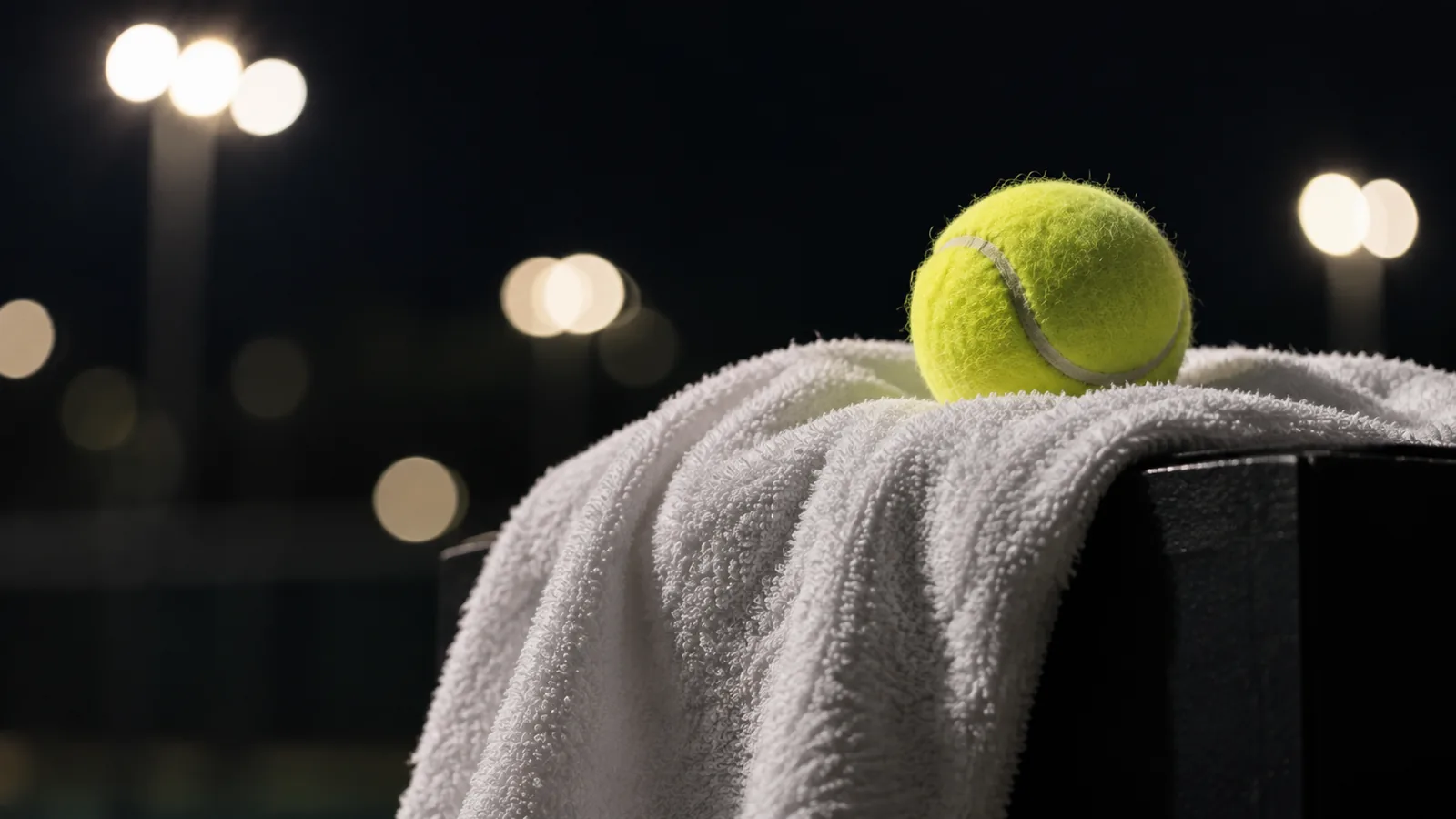
Most of a tennis match happens when the ball isn't moving. In a 2007 study of eight elite junior girls, only 21.9 percent of match time was actual playing time. The rest was the walk back, the towel and the bounce. The rules give you up to 25 seconds between points. Here's what the best players do with that time, and a version you can steal.
The 25 seconds, by the rules
The Rules of Tennis say it plainly: "Between points, a maximum of twenty-five (25) seconds is allowed." You get 90 seconds at a changeover and 120 seconds between sets. USTA junior events follow the same rule.
At the pro level the clock is visible. In 2018, the US Open put a 25-second clock on every court for main draw matches, and the ATP announced clocks for all its events from 2020. At the 2026 Australian Open, the clock started as soon as a point ended. When the ATP trialed that in June 2024, Carlos Alcaraz said, "I felt like I was in a rush all the time. I had no time to bounce and do my routine." If the routine matters to him, it matters to you.
The four-step reset
The late sport psychologist Jim Loehr studied what champions did between points and turned it into a model he called the 16-Second Cure. It has four stages, and it's a coaching model built from watching players, not a lab study. Here it is in plain words:
1. Respond. In the first few seconds, react to the last point on purpose. Turn away, switch the racket to your other hand, get your shoulders back. Good point or bad, it's over.2. Recover. Walk slowly. Breathe. Look at your strings. This is the part most juniors skip.3. Reset. Know the score and pick a plan for the next point: where the serve goes, or where the first ball goes.4. Ritual. The same bounces, the same breath, every time. Then play.
Why it works
Your body recovers faster than you think. A 2023 study of 13 male juniors found the first 25 seconds were enough for heart rate and oxygen uptake to recover significantly after a hard rally drill. It was a drill, not a real match. In a small 2021 coaching study of two young Canadian players, when they skipped their pre-set routine, they had more than a 50 percent chance of losing the next point on an unforced error.
The breath is the easiest lever. A 2023 Stanford study found that a few minutes a day of breathing with a long, full exhale improved mood and slowed breathing more than meditation did. That study was daily practice, not mid-match. One slow exhale in step two is the same idea, shrunk to fit a point.
What the pros say
Rafael Nadal explained his famous routine in his 2011 autobiography: "It's a way of placing myself in a match, ordering my surroundings to match the order I seek in my head." Novak Djokovic once admitted that he "wasn't even aware" how much he bounced the ball, "especially at important moments."
Aryna Sabalenka, after winning the 2025 US Open, described the goal of all of it: "I'm not going to let (my emotions) take control over me, and doesn't matter what happens in the match."
Build your own
Write your four steps on a card and bring it to practice. You're allowed to read notes you wrote before the match, so it can sit in your bag on match day too. Run the routine after every point in a practice set, even the easy ones. It only works under pressure if it's automatic before pressure shows up.
If big moments get to you, read why players choke and how the best recover. If it starts before the first ball, start with pre-match nerves.
Build a profile that does the work for you.
How much time do you get between points in tennis?
Up to 25 seconds. The Rules of Tennis allow a maximum of 25 seconds between points, 90 seconds at a changeover and 120 seconds between sets. USTA junior tournaments follow the same limits.
What is the 16-second cure in tennis?
A between-points routine developed by the late sport psychologist Jim Loehr from watching top players. It has four stages: a positive physical response to the last point, relaxation, preparation for the next point, and a ritual before you play. It is a coaching model, not a lab-tested protocol.
What should you do between points in tennis?
Use the same short routine every time. Let the last point go, walk and breathe with a slow exhale, decide your plan for the next point, then go through your ritual, like the same number of ball bounces. Practice it until it's automatic.
Sources: ITF Rules of Tennis (USTA Friend at Court 2026); Sports Illustrated; Sky Sports; Australian Open; Jim Loehr (16-Second Cure); British Journal of Sports Medicine; International Journal of Sports Science & Coaching; ITF Coaching & Sport Science Review; Cell Reports Medicine; Rafael Nadal, Rafa (2011); Al Jazeera; Gulf News