
What Should You Eat Before a Tennis Match?
Carbs you know, a few hours out, and steady drinking at every changeover. A match-day eating plan built on sports nutrition guidance.
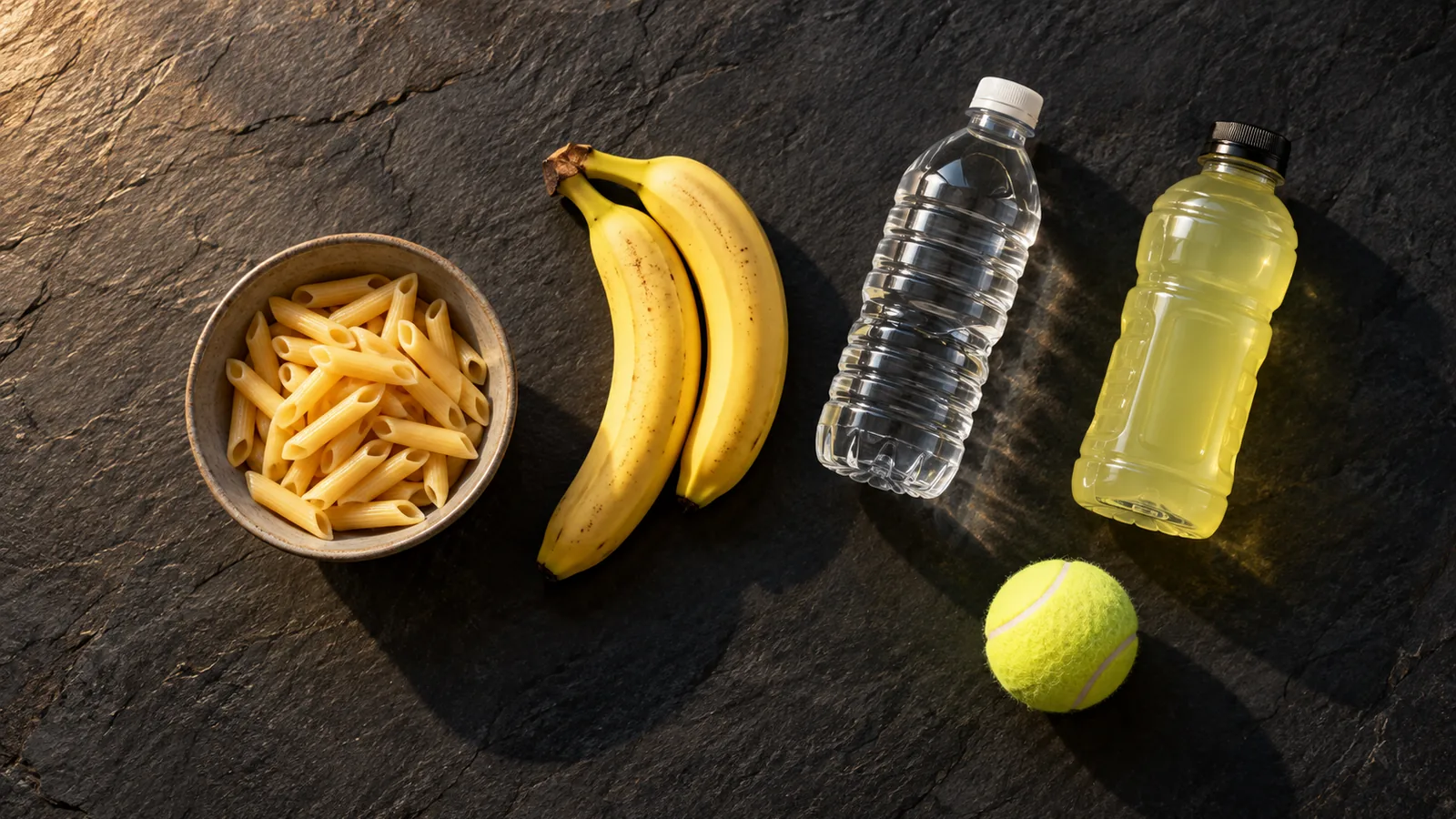
Eat a normal, carb-heavy meal a few hours before you play, keep anything close to match time small and simple, and drink at every changeover. That's the whole idea. The numbers below come from a 2016 joint position stand by the American College of Sports Medicine and two dietitian groups, plus a 2013 review written for tennis. Both were written for adult athletes, so treat them as a guide, not a prescription. Here's the day, with the math for a 121-pound (55 kg) junior.
The night before and the morning of
Nothing fancy. A real dinner with carbs, a real breakfast. Alex de Minaur described his day at the 2026 Australian Open: "I made sure I had a good dinner last night. This morning was all over good breakfast... some plain pasta before I went on."
The most important rule is about timing, not food: don't try anything new on match day. The position stand tells athletes to practice their fueling plan to find what suits their goals and their stomach. Test it at practice, not in the first round.
One to four hours out
The guidance is 1 to 4 grams of carbohydrate per kilogram of body weight, eaten 1 to 4 hours before you play. For a 55 kg junior, that's 55 to 220 grams of carbs. A full meal fits further out. Closer to the match, go small and easy, like a banana or a plain bagel.
Close to play, foods high in fat, protein or fiber "may need to be avoided." Pick things that are low in fiber and easy to eat. For fluid, the stand suggests 5 to 10 milliliters per kilogram in the 2 to 4 hours before. For the same junior, that's about 9 to 19 ounces.
During the match
The tennis review recommends about 200 milliliters (roughly 7 ounces) of fluid with electrolytes at every changeover below about 80 degrees Fahrenheit, and up to 400 milliliters (about 13.5 ounces) when it's hotter. Once a match goes past two hours, it suggests 30 to 60 grams of carbs per hour. Bananas and sports drinks are the usual way to get there. In a 2018 survey of 70 competitive players, most of them college-age, 86 percent listed bananas among what they eat during matches.
The American Academy of Pediatrics says water should be the main drink for kids and teens, and that sports drinks have "a limited function," mainly "during prolonged, vigorous physical activity." A long tournament match often qualifies. Energy drinks never do. The authors of the AAP's 2011 report put it bluntly: "Energy drinks are never appropriate for children or adolescents."
Cramping at 4-4 in the third
Most people blame cramps on dehydration. The research is less sure. A 2022 review in the Journal of Athletic Training found cramps come from "a confluence of unique intrinsic and extrinsic factors rather than a singular cause," with fatigue one of the main contributors. Its recommended treatment for a cramp in progress: gentle stretching.
Good fueling and drinking won't guarantee you never cramp, and the review found the evidence for any prevention method is thin. Fueling well is still the part you control. On hot days, the plan in how to play your best tennis in brutal heat matters even more.
Two matches in one day
Chips and an energy drink in the parking lot is the classic junior mistake. If you have eight hours or less before your next match, the position stand suggests 1 to 1.2 grams of carbs per kilogram per hour for the first four hours, as small regular snacks. For a 55 kg junior, that's about 55 to 66 grams of carbs an hour. Add some protein too: by the stand's general recovery math, about 15 grams for the same junior. Think a sandwich, fruit and chocolate milk, not a feast.
Weigh yourself before and after if you can. The guidance is to drink 1.25 to 1.5 liters for every kilogram you lost. The full routine is in how to recover between two matches in one day. For a plan built around your own body, talk to a sports dietitian.
Build a profile that does the work for you.
What should a junior tennis player eat before a match?
A normal, carb-heavy meal a few hours before, then something small and easy, like a banana, closer to match time. Sports nutrition guidance for athletes suggests 1 to 4 grams of carbs per kilogram of body weight in the 1 to 4 hours before play. Avoid heavy, high-fat or high-fiber food right before you play, and don't try anything new on match day.
How much should you drink during a tennis match?
A tennis-specific review recommends about 200 milliliters (roughly 7 ounces) of fluid with electrolytes at every changeover below about 80 degrees Fahrenheit, and up to 400 milliliters (about 13.5 ounces) when it's hotter. Water should be the main drink for kids and teens, with sports drinks for long, hard matches.
Can teenagers drink energy drinks before a tennis match?
No. The authors of a 2011 American Academy of Pediatrics report said energy drinks are never appropriate for children or adolescents. Use water, and a sports drink during long, hard matches.
Sources: American College of Sports Medicine, Academy of Nutrition and Dietetics and Dietitians of Canada (Nutrition and Athletic Performance, 2016); Journal of Sports Science and Medicine (Nutrition for Tennis, 2013); American Academy of Pediatrics; Journal of Athletic Training; Nutrients; Australian Open