
What Do Tennis Players Pack for Life on the Road?
Tennis travel essentials, by the evidence: what pros carry across 12 time zones, the $899 gadget that does the least, and the kit under $200 that works.
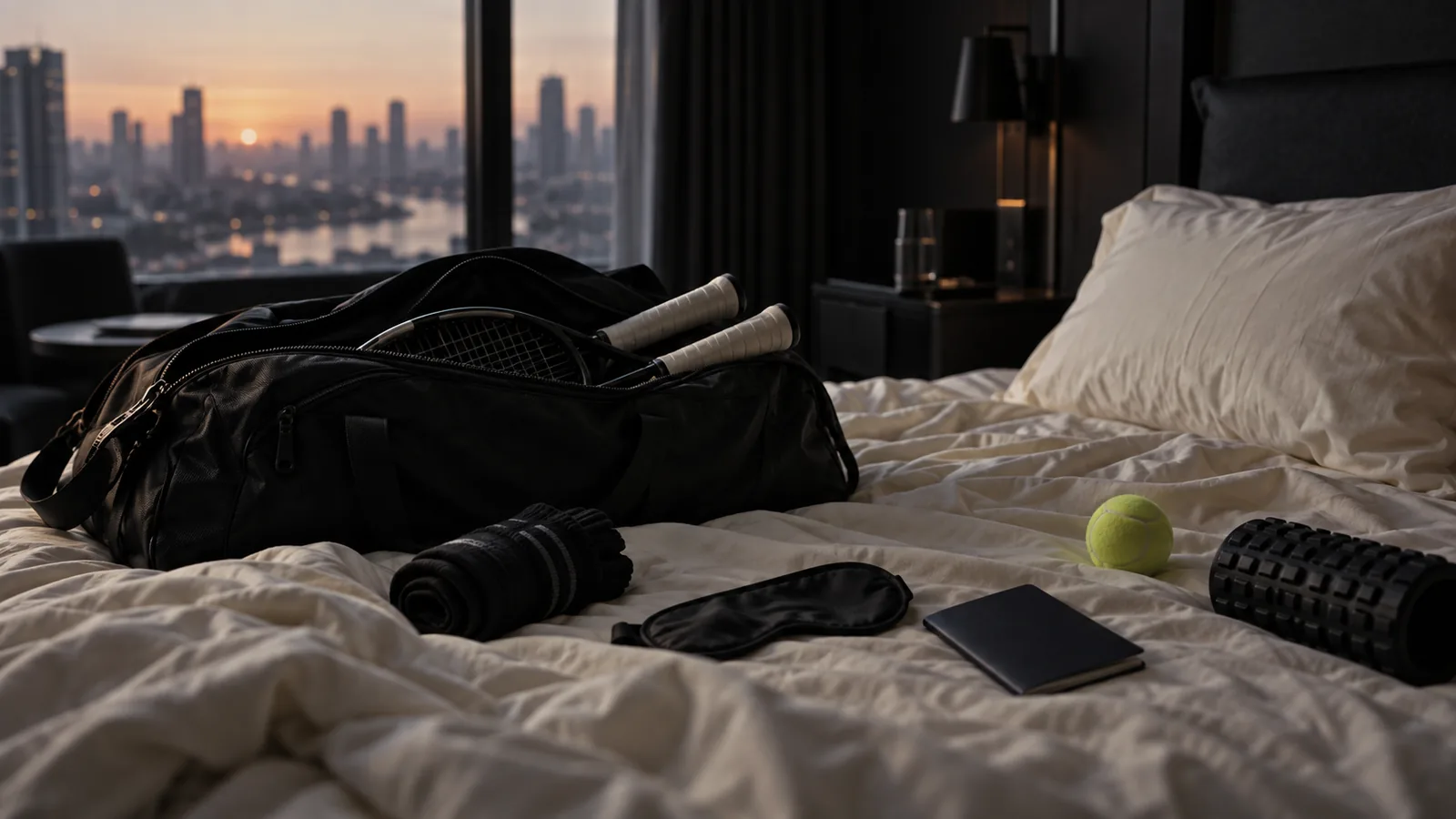
The 2026 US Open ends on September 13, and the ATP's next main draws opens in China ten days later, 12 time zones east. The CDC puts the body's eastward adjustment at about one hour a day, so the math does not work and the bag has to. The bag worth copying costs under $200: the pillow from home, a sleep mask, socks for the long haul, electrolytes, one recovery tool with evidence behind it, and a clock routine that starts on the plane.
Forty hotels a year
Daniil Medvedev put the problem in one breath after a match in Dubai in February 2026. "The balls are different, the courts are different... The hotel is different, the bed is different, the pillow is different." Then the line that matters: "Imagine doing this 40 times a year, and we do."
It starts younger than the tour. Iva Jovic, a top-20 player at 18, described the job in October 2025 as "new rooms, new courts, new balls, new surfaces" and admitted, "I don't even know what day of the week it is anymore!"
Start with the pillow
Novak Djokovic, asked what he never travels without, did not name a racquet. "My pillow. I have a longer neck, and for years, hotel pillows were just killing me. So now I carry my own Tempur-Pedic pillow with me everywhere." The USTA's own travel page for players puts it in one line: "Carry your own pillow!"
Madison Keys travels with a silk eye mask and a little Hatch sound machine she says cost "about $30 on Amazon." Her reason is the whole philosophy of tour travel: "Having my sleep mask and sound machine, no matter where I am in the world, is my one consistent routine." Jannik Sinner, asked in March 2026 how he recovers, skipped every gadget. "Sleeping is the best recovery we can have." The pillow is not a quirk. It is the tool.
The plane, then the clock
Cabin air runs at 10 to 20 percent humidity, per the CDC. The WTA's jet-lag sheet tells players to drink "at least 300mL an hour," skip coffee, tea, cola and alcohol, and get up and walk. Ben Shelton keeps it simpler: "I'm usually just drinking water. But those Biscoff cookies that they give you on Delta flights, those are my all-time favorite." A Cochrane review of 12 trials found high-certainty evidence that graduated compression stockings cut the rate of symptomless blood clots on flights of more than five hours.
Then the clock. A 2021 consensus statement on jet lag in athletes puts adjustment at one day per time zone eastward. New York to Beijing by that rule is close to two weeks, and the ATP gave players ten days. So the pros cheat. Frances Tiafoe, a 2026 US Open semifinalist: "For a couple days, just tell yourself you're not tired, even though you're dying." Casper Ruud's rule for flying east: fill the arrival day, "because if you fall asleep before 8 or 9 p.m., then you're screwed." The WTA sheet agrees: sunlight on landing, local meal and sleep times, a light session on day one, be social. Amanda Anisimova adds "Take melatonin for the first few nights!" The CDC says 0.5 to 1 mg is often enough for adults. For a junior that is a pediatrician question.
The recovery kit, with price tags
Ruud flies with an inflatable massage table. Compression boots are the status item: Therabody was named the ATP Tour's official recovery partner in November 2021, and Hyperice's Normatec 3 Legs list at $899. A 2024 meta-analysis of 17 studies found "a trivial to small benefit" to muscle function and "a trivial to moderate effect for pain and soreness." They feel great. The evidence says that is mostly what they do.
Massage guns ($149 for a Hypervolt Go 3) have better evidence, with one catch: the 2023 review that found acute gains in strength, flexibility and pain also found static stretching matched them for flexibility. A $40 foam roller belongs in the warm-up; a 2019 review called its recovery effects "rather minor." Wearables were the fight of 2026: the ITF approved them for matches, the Australian Open made Alcaraz, Sinner and Aryna Sabalenka take theirs off in January, and the other three Slams then allowed them on trial. They measure sleep. They do not create it. (How pros recover between two matches in one day →)
The rest is personal. Coco Gauff does not pack her racquets, her coach does, because he re-grips each one fresh daily, which is how she walked out at Roland Garros in 2025 with none. And Djokovic's system is the one every touring junior eventually arrives at: "If you never unpack, then you never have to worry about packing."
The junior version of the bag
The road starts early. The ITF says 13-to-16-year-olds on the international pathway should play 50 to 70 high-quality matches a year, and a USTA national ranking counts your best six tournaments, many of them out of town. If you are playing the right number of events, the travel is not optional. The kit is the only variable.
Build it from the evidence. The pillow from home costs nothing. A sleep mask is under $40, earplugs a few dollars. Compression socks run $45 to $60; the clot evidence is adult and long-haul, so for a healthy junior they are a comfort item, not a safety item. A foam roller is $40. Electrolyte sticks are $1 to $2 each, and the logic that works in brutal heat works at 35,000 feet. The whole kit is under $200 and covers everything the tour's physios actually recommend. Skip the $899 boots until someone else is paying.
The player who lands ready plays the first round on local time. Everyone else plays it at 3 a.m. Put the road on the record while you are at it.
Build a profile that does the work for you.
How do tennis players deal with jet lag?
They start on the plane and shift on arrival. The WTA's performance health team tells players to drink at least 300 mL of water an hour in the air, skip coffee and alcohol, and walk the aisle, then on landing get natural sunlight, eat and sleep on local time, train lightly on day one and be social. The CDC says the body advances about one hour a day flying east and about 1.5 hours a day flying west, so a trip like New York to Beijing takes most of two weeks to fully absorb.
What do pro tennis players travel with?
Their own pillow is the most common answer, from Novak Djokovic to the USTA's travel guidance. Add a sleep mask, noise-cancelling headphones, compression socks for long flights, electrolytes, and a massage gun or foam roller. Personal extras range from Casper Ruud's inflatable massage table to Taylor Fritz's gaming laptop.
Are recovery boots worth it for a junior tennis player?
Probably not at $899. A 2024 meta-analysis of 17 studies found pneumatic compression gave a trivial to small benefit to muscle function and mainly reduced perceived soreness. The items with real evidence behind them are sleep, hydration, graduated compression socks on flights over five hours (clot prevention in adults, high certainty per Cochrane), and a foam roller used in the warm-up.
Sources: ATP Tour; WTA Performance Health; USTA; CDC Yellow Book; Sports Medicine (Janse van Rensburg et al. 2021); Cochrane; Biology of Sport; International Journal of Sports Physical Therapy; Frontiers in Physiology; ITF; Tennis.com; Sports Illustrated; Travel + Leisure; Bloomberg; Marie Claire; Yahoo Life; Miami Living Magazine; Front Office Sports; CLAY (claytenis.com); Therabody; Hyperice