
What's the Best Junior Tennis Racket?
The right junior tennis racket fits your kid's height, ball color and swing, not the pro on TV. Sizes, weights, prices, and when to switch to adult.
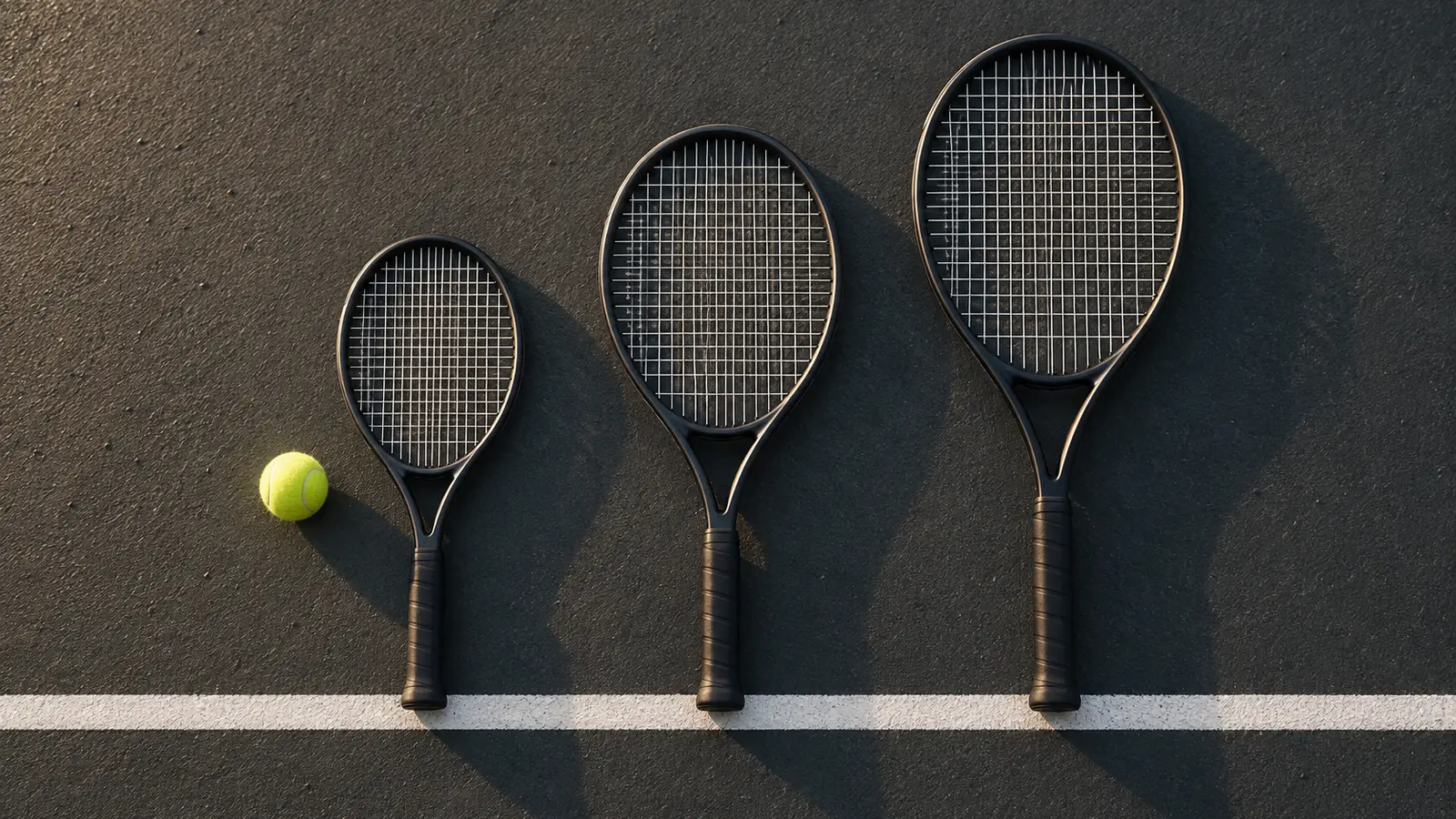
Your kid wants Carlos Alcaraz's racket. Babolat sells it: the Pure Aero 98, 27 inches, 305 grams unstrung, $309. Babolat also sells a Carlitos Junior, "inspired by champion Carlos Alcaraz," in aluminum, for $59, from 19 to 26 inches. The brand that makes his racket does not hand it to a 10-year-old, and neither should you. The best junior racket is the one that fits right now: the right length for their height, the right weight for their swing, and the right size for the ball they play.
Size it by height, not the box
The quick test comes from the USTA. Have your kid hold the racket at their side with the head pointing down. The head should sit just above the floor without touching it. Brand charts roughly agree on the rest: 17 to 21 inches for the youngest players, 23 inches around ages 7 and 8, 25 inches around 9 and 10, and 26 inches from about 11. Babolat's chart moves kids to adult length once they pass about 1.5 meters, roughly 4 feet 11.
The charts disagree at the edges, by a year here and an inch there. That is why height beats age. A tall 9-year-old and a small 12-year-old can need the same racket.
The ball color sets the limit
If your kid plays 10-and-under events, the ball decides for you. USTA red ball rules cap rackets at 23 inches and orange ball rules at 25, and the ITF recommends the same lengths. Red ball courts run about 36 feet long in USTA play, orange about 60. Green ball moves to the full 78-foot court, where the ITF's guidance puts advanced 9- and 10-year-olds on a 25- or 26-inch racket.
When to switch to an adult racket
HEAD says kids tend to move to its adult frames from about 11. Wilson says "there's no exact formula." Babolat keeps players under 1.5 meters on junior frames and moves young teens to its Lite adult models. The honest answer: when they are tall enough and strong enough, not when their friends switch.
There is also a case for waiting. A 2023 study in Frontiers in Psychology had nine intermediate-level competitive players around age 10 serve with 23-, 25- and 27-inch rackets. Serve speed was about the same with all three, and the shortest racket put the least load on the shoulder and elbow. It was a small study of serves only, but the title says it plainly: "There is no rush to upgrade."
The bridge: 26-inch graphite, then light adult frames
Between the $59 aluminum junior and the $300 pro frame sits the smart buy. Graphite 26-inch juniors run about $119 to $159 and weigh around 250 grams: the Babolat Pure Aero Junior 26 ($149, 250 grams), HEAD Speed Jr. ($119, 255 grams) and Wilson Blade 26 (about $159, 255 grams). They look like the pro versions and play like rackets built for a kid.
When they reach adult length, start light. Babolat's Pure Aero Lite is 270 grams and the Pure Aero S Lite 255, at $279 and $269: the same family as Alcaraz's frame, 35 to 50 grams lighter. A good coach will tell you when to step up, which makes picking that coach part of the racket decision too.
Grips and strings, the parts parents skip
Most junior rackets come in one universal grip size. On adult frames, if your kid is between two grip sizes, go smaller and build it up with an overgrip. That is Wilson's advice, and the logic is simple: it's far easier to build a handle up than to shave one down. Lurie Children's Hospital adds that the grip should not rotate in the hand on contact.
Strings matter more than most parents think. Babolat says its stiffer monofilament strings, the polyester type, are not suitable for players under 12, with one softer exception, and steers kids to multifilament. Lurie Children's warns that a racket that is too heavy or too light, or strung at the wrong tension, "can contribute to shoulder and elbow problems."
A racket is one line in the real cost of junior tennis, and it is a line you will pay more than once. Buy the one that fits, and buy again when they grow. If your junior's results are strong enough, racket brands take sponsorship applications that can cut the bill.
Build a profile that does the work for you.
What size tennis racket should my child use?
Size by height, not age. Have your child hold the racket at their side with the head pointing down; the head should sit just above the floor. As a rough guide, most brand charts put 23 inches around ages 7 to 8, 25 inches around 9 to 10, and 26 inches from about 11, with adult length from about 1.5 meters (4 feet 11) tall.
When should a junior switch to an adult tennis racket?
Often from about age 11 into the early teens, once they are about 1.5 meters (4 feet 11) tall and strong enough for a heavier frame. Brands disagree on the exact age, so let height and strength decide. There is no rush: a small 2023 study of nine young players' serves found speed held steady with shorter rackets while shoulder and elbow loads dropped. Start with a light adult frame around 255 to 270 grams.
Should a kid use the same racket as a pro?
Not the pro model itself. The retail Babolat Pure Aero 98, the model Carlos Alcaraz plays, weighs 305 grams unstrung and costs $309; the same family comes in 26-inch junior graphite versions around 250 grams and light adult versions from 255 grams. A kid gets the look without the weight.
Sources: USTA (Find the right tennis racquet size; Net Generation Pathway Regulations); ITF (Rules of Tennis 2026, Appendix VIII); Babolat; HEAD; Wilson; Tennis Warehouse; Frontiers in Psychology (Touzard et al., 2023); Lurie Children's Hospital of Chicago