
Academy, Club, or School Team: Choosing the Path
Most juniors never need an academy. Some genuinely do. How to match the path to your kid's level, goals and family budget, without buying status.
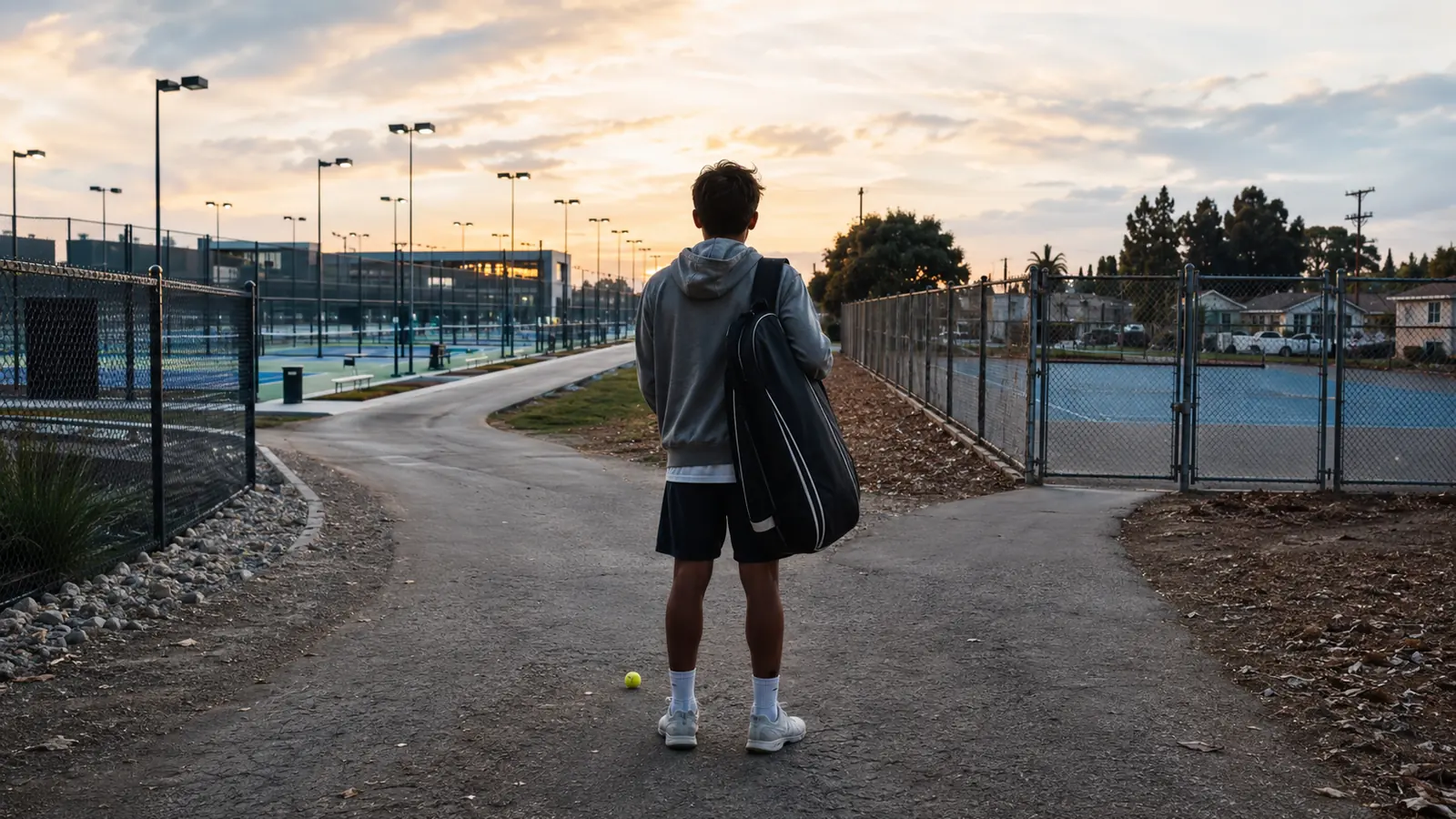
Two of the greatest careers in tennis history began with opposite decisions. Nadal, at 14, declined the federation move to Barcelona, stayed in Mallorca and trained with his uncle Toni, later writing that he was glad he never left. Sharapova's father arrived in Florida with $700 and no English to chase a Bollettieri academy spot for his daughter. There is no one correct path in this sport. There is only the correct path for a specific kid, at a specific level, this year.
Here is how to find yours without paying for someone else's.
What each path actually is
The club or local program is where nearly every good player should start and where most should stay longest. Group clinics plus targeted privates, school and normal life intact, costs that scale from a few hundred dollars a month. Its ceiling is real but much higher than academy marketing suggests: sectional titles and college tennis come out of club programs constantly.
The school team is the free layer families undervalue. Daily reps, doubles, leadership, and the only version of tennis with teammates. It can coexist with either other path, and for most players it is absolutely worth the season.
The academy is the full-immersion tier: training built around tennis, school rebuilt around training, often boarding. The flagship programs run from the tens of thousands to around $90,000 or more per year for boarding students, with credible all-in estimates for residential training and travel at $60,000 to $100,000. Some players genuinely need this density. Most are sold it early.
The questions that actually decide it
Is your kid winning the level in front of them? The academy conversation starts only after the current level is conquered and the local ceiling is provably hit. Win the rung you are standing on, then reach.
Who is asking for more tennis? If the kid is begging for a second session and the parent is checking academy websites, healthy. Reversed, dangerous. The research on early specialization backs the caution: the American Academy of Pediatrics recommends delaying single-sport specialization until around 15 or 16, and USTA player development guidance builds in sport sampling and at least two months away from tennis a year for younger players. The all-in leap at 11 is not just expensive. It is developmentally early.
Does the math survive honesty? A year of boarding academy costs more than most college educations. If the family goal is a college scholarship, run the numbers side by side, because the scholarship math rarely repays a six-figure junior career. If the goal is the pro tour, be honest about what percentage of academy kids get there, and remember the hours rule most medical bodies endorse: no more training hours per week than the kid's age.
The blended middle most families miss
The 2026 reality is that the paths mix. Strong club training plus a homeschool or online-school schedule now replicates most of an academy's court time at a fraction of the cost, and top coaches openly recommend it for nationally competitive kids. Day-academy programs split the difference. A junior can climb a long way on club coaching, school-team leadership and a smart tournament calendar before boarding ever needs discussing.
Whatever the path, one asset transfers across all of them: proof. Results, video, a visible body of work. The player with a findable record makes every next door easier to open, from academy scholarships to college offers. Build the record wherever you train.
Build a profile that does the work for you.
Should my kid go to a tennis academy?
Only if they are consistently winning at their current level, asking for more tennis themselves, and the family finances survive an honest look. Full-time academies suit a small slice of juniors; most develop as well or better through strong club programs plus a smart tournament schedule.
How much does a tennis academy cost?
Elite US boarding academies list tuition around $90,000 or more per year, and credible all-in estimates for residential training with tournament travel run $60,000 to $100,000 annually. Day programs and club training cost dramatically less.
When should a junior specialize in tennis?
The American Academy of Pediatrics recommends delaying single-sport specialization until late adolescence, around 15 or 16, and athletic-training guidance suggests kids train no more hours per week than their age. Before that, sampling sports and taking regular time off supports better long-term development.
Sources: American Academy of Pediatrics; Johns Hopkins Medicine; National Athletic Trainers' Association; USTA; Rafa (Nadal autobiography); CNBC; Long Island Tennis Magazine